

Our websites offer information mostly for educational purposes with no intent to alter health care protocols nor to serve as a sole source of medical information.
Always seek the advice of your local health care provider.
|
× UKRAINIAN CHILDREN WITH DISABILITIES HAVE SPECIAL NEEDS |
WHISTELING FACE of FREEDMAN SHELDON SYNDROME
Suffocate Whistle Wheeze Whisper
Sibilant Sibyl
Souffle Insufflate Blow Hiss
Words concerned with critical concepts gain clarity when the panorama is expanded by exposing clusters of complementary words.
The core cluster "lip, lick, kiss, slick, spit"; amplified by the clusters "os, stomach, abdomen"; "buccal, oral, chew"; "drink, eat"; "swallow, deglut, glutton"; "tongue, glossary, glottis"; "throat, throttle, faucet, pharynx"; and "lip, vermillion, philtrum" have already been explored in other illustrated overviews. This overview expands the panorama by exploring the relationships of SIBYL, SIBILANT, HISS, WHISPER, WHISTLE, inSUFFLATION for "to BLOW", SUFFOCATE, SOUFFLE and STIFLE. Note that we exclude from this overiview notions linked to WHEEZING and its relation with BRONCHIAL ASTHMA.
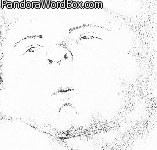
Pouting or pursed lips caused by facial muscle contractions.
This child "facies" is suggestive of a condition known as
Whisteling Face or Freeman Sheldon Syndrome
This child "facies" is suggestive of a condition known as
Whisteling Face or Freeman Sheldon Syndrome
Persons with a "Whisteling Face" may suffer from a syndrome (collection of signs and signals) due to a serious genetic mutation impacting mostly muscles (a myopathy of genetic nature). Some attach to this syndrome the names of Freedman - Sheldon. Other terms for the syndrome include WIndimill Vane Hand, Craniocarpotarsal, Craniocarpotarasal and Distal Artrogryposis The disorder is often inherited for either parent. Women may have milder manifestations which implies that astute clinicians need to examine mothers of babies with "puckered" lips with great care. Those with the disorder transmit the disorder to half of their children of either sex - the disorder is due to an autosomal dominant mutation. The symptoms and signs of this disorder is given in companion websites. It suffices to say here that the involved muscles distort the development of limbs, digits in particular, tongue and in some instances the heart musculature. As is the case with many myopathies, general anesthesia may trigger malignant hytperthermia which is a serious complications. In Biology, organisms such as Sibyllina sibyllonautilus point out that the story about the love of Apollo for the Cumaean Sibyl captured the imagination of early pioneers studying the nature of life and our quest for the longevity of love, a task left to poets to complete.
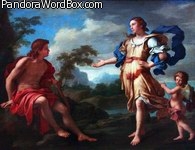
Apollo granting longevity to the Cumaean Sibyl
" ... the mad prophetic Sibyl,
your shall find,
dark in a cave ...
she sings the fates, and
in her frantic fits,
the notes and names,
inscribed to leafs commits ...
what she commits to leafs,
in order laid,
before the caverns entrance are displayed ..."
(The Aeneid by Virgil, translated by John Dryden)
The roots of Sybilant point toward the most celebrated among Sibyls - the prodigious Sybil of Cumae. Loved by Apollo, she was granted as many years of life as the number of grains of sand would fit in her hand but she forgot to ask for enduring youth. With passing centuries, she aged and became a well known augur who SIBILATED or WHISPERed the will of gods. When Aeneas met her she was 700 hundred years old, quite senile and shrivled. She survived in a bottle hanging from the ceiling of the cavern in Cumae near the entrance of Hades or Hell. Virgil asserts that the Sybil guided Aeneas to the underworld in search of his beloved Dido.
The WHISPERed prophecies of the cumaen Sibyl were recorded in leaflets and compiled by the ancient Romans into twelve Sibylline books. The books were preserved in the temple of Jupiter until the temple burned down in 83 BC. The extant Sibylline books known today are different. They represent a medley of prophecies dating to the early Christian era composed by Alexandrine Jews and Christians, in the interest of their respective religions.
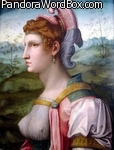
Sibyl ?

Sibilant Erythraean Sibyl
Sibyl and SIBILARE in Latin, point to HISS, WHISPER and WHISTLE which are expanded in Spanish by SILBAR or CHIFLAR and CHIFLADO for whistling and for those with diminished "mental sense". Perhaps these meanings underscore that senility not only reduces many of us to "whispering" but also to insanity. SIBILARE or WHISPER in Latin also point to SUFFOCATIO for STIFFLE or SUFFOCATE.
Provocatively, Sibyl in Latin is also VOLAE implying that they spoke about the WILL of gods. Note that "VOLA" in Ukrainian precisely means WILL. The implication in SYBIL - VOLAE is that prophecies implicitly impact the WILL or VOLITION including of men who are VOLATILE or VILE.
Another "axis" of meanigs from SYBIL point to SUFFLATIO (blow or emanate) as in STIFLE, INSUFFLATE and SUFFOCATE. Perhaps these elements also reflect the fact that the cavern of Cumae was located on the volcanic fields surrounding Mt. Vesuvius. The area is called FLEGREAN for FLAME as in conFLAgration and is permeated with emanations of mephitic volcanic vapors.
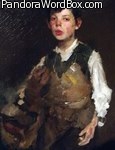
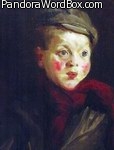
Whistling makes lips pucker or pout
To close on a lighter note, SUFFLATIO and SIBYL and their relation to blow, breath and whisper lead us to SOUFFLE. A SOUFFLE arises by inSUFFLation or blowing air into what otherwise would be a vulgar heavy omelette. To make a light, fluffy SOUFFLE is an art that delights gourmands and is a sure way to STIFLE and SUFFOCATE any negative WHISPERS about a chef. Perhaps the art of SOUFFLE making should be a complement to other artistic achievements inspired by the Sibyl such as are the magnificent frescos by Michelangelo on the ceiling of the Systine chapel or the poems by Virgil in the AENEID.
20100311 ww