



Our websites offer information mostly for educational purposes with no intent to alter health care protocols nor to serve as a sole source of medical information.
Always seek the advice of your local health care provider.
|
× UKRAINIAN CHILDREN WITH DISABILITIES HAVE SPECIAL NEEDS |
FACE FACIES
Facade Facetius Facet
Facial expressions, akin to music, transcend the barriers of languages.

In biologic terms, the FACE is a relatively flat anterior (ventral) and inferior (cuadal) area of the skull (cranium). From the flat facial FACET protrude the NOSE and LIPS (more so in persons of some ethnic groups). In one sense, the face is the location of SENSORY ANTENA-LIKE SENSORY ORGANS, such as the OCULAR, OLPHATORY, and GUSTATORY ORGANS. In Medicine, FACIES denotes "faces that talk or send a message". In CLINICAL MEDICINE, a FACIES lays the fastest path toward a diagnosis. Diverse facial expressions are an integral companion of every language. Contrary to words, which are peculiar to specific languages, facial expressions of joy, revulsion, fear, panic, pain, among others, are understood universally. In fact, the public can recognize the "dull facies" of the mentally "retarded", including those with "Mongolism" (an increasingly offensive term - an alternative is to use the term Down syndrome). In short, the face reflects degrees of cerebral development through a link of emotions to facial skin musculature, giving rise to facial gestures - for example, the "risorius" muscle gives rise to the "risa", or smile in Spanish. Primates have the most developed system of "facial expressions", which complements verbal communications.
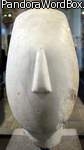
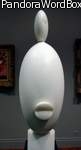
Prominent noses or lips are more common among some ethnic groups, a fact stressed by ancient and modern artists alike
The face is like a FACADE that displays or hides feelings. In FACT, the face is a FACTORY of signals that lend humans the FACULTY to show their emotions, such as pain, pleasure, surprise, or to be FACETIOUS or FLIP (inapprropriate remarks or humor concerning serious issues). A GRIMACE, in some languages implies a "whim" and may be in tune with cultural FASHIONS or FACETS (the French often pucker their lips in contrast to Slavs). To distinguish true from false faces, in particular those of politicians, a Spanish journal gave the names "Caras y Caretas" (faces and masks) to denote political falsehoods MASKED by FALSE FACIAL GESTICULATIONS. This last aspect brings us to MASK, which may be a false face or facies hiding or misleading or a covering of the face for whatever intent.
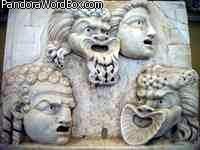
Actors and other artists strive to express facial feelings that convey the nature or portrait of those portrayed. Infants recognize the meanings of facial expressions before they grasp the meanings of words. Mothers are also the best at recongizing the facies of their infants indicating joy, fear, or illness

Optimist

Pessimist

Democritus

Heraclitus


A pessimistic "facies" of an Emperor aware that "All is in Flux" and an optimistic facies of a Philosopher convinced that "All that is, is the best (possible)"
It is of interest that with the advent of telecommunications and imaging technologies the value of "face to face" communications stands undiminished. An index of this fact is the travel schedule of Secretaries of State or those who pay vast sums to attend all sorts of "concerts in vivo". The rational is that "reading faces and facies" remains an essential component of communication.
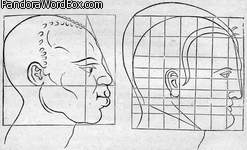
Approaches to quantify Physiognomy
Strictly speaking, the terms "face", "facies" and "physiognomy" are synonymous. Howerver, in medical terms, "looking at a face" implies "looking for a facies". For example, a Clinical Geneticists may find in a face signs peculiar to Achondroplasia. Such realization may accelerate the diagnosis and formulation of early, context specific health care interventions.


Individuals with achondroplasia have a typical facies, particularly a "pug" like nose
More than a century ago, interest in PHYSIOGNOMY (phyein for "to engender" and gnomo for "to judge") reached its peak. Enthusiasts then believed that the face was not only "a window to the soul", as asserted by many proverbs, but also an indicator of health, disease, and mental status. Physiognomy was linked with PHRENOLOGY. Early applications were oriented to better understand the human mind and not as today, to understand physical prenatal development. Among early enthusiasts, many were tainted by dogmatic religious and political convictions. An emphasis on premature applications to detect socially undesirable individuals ultimately led to the loss of credibility and the demise of this approach until the advent of modern DYSMORPHOLOGY. As mentioned above, Clinical Geneticists interested in Dysmorphology (study of altered shapes and proportions) have the ability to suspect many disorders from a peculiar facies as in the case of Achodroplasia or Down syndromes.


The achondroplasia "facies" is characteristic - note the "saddle"-like nose and prominent forehead
20220328 ww